

Photo: © Amanpuri
Amanpuri, Phuket’s discreet icon above the Andaman Sea
First-born of the Aman constellation, Amanpuri rises on a Phuket peninsula like a contemporary temple to stillness. Conceived in 1988 by Adrian Zecha with architect Ed Tuttle, this Sanskrit “place of peace” is rooted in a former coconut plantation that slopes towards the Andaman Sea and Pansea Beach. Ayutthaya-inspired roofs, weathered teak and dark granite create an almost monastic setting, where the rustle of palms replaces the bustle of major beach resorts. Through this pioneering address, an intimate, exacting Thai art of living is quietly revealed behind every pavilion and villa.

Amanpuri, the pioneering “place of peace” on Phuket’s peninsula
The first resort in the Aman collection and the brand’s flagship property, Amanpuri holds a singular place in the story of high-end hospitality. Opened in 1988 on the west coast of Phuket, it was born from the intuition of Adrian Zecha, who believed that the most discerning travellers sought not spectacle but serenity, precise service and a close relationship with the landscape. The chosen site, a former coconut plantation overlooking the Andaman Sea and including part of Pansea Beach, offered the contours, shade and sense of space required for such a project.
The resort’s very name, “Amanpuri”, means “place of peace” in Sanskrit. That intention runs through the entire property, from the layout of the buildings on the secluded peninsula to discreet back-of-house routes designed to preserve guests’ tranquillity. Located on Pansea Beach, Cherngtalay, in the district of Thalang, Amanpuri lies about 24 kilometres from Phuket International Airport, a journey of roughly 30 minutes. Guests staying three nights or more enjoy private transfers between the airport and the hotel, reinforcing the feeling of gradually stepping into a world apart.
From the outset, Amanpuri set the tone for a discreet, contemplative style of luxury, far removed from ostentation. The property was conceived as an intimate retreat, structured around pavilions and villas designed as private homes, each in dialogue with the coastal topography and the original coconut groves. This vision would later influence other high-end island destinations in Thailand, among them Phulay Bay, a Ritz-Carlton Reserve in Krabi, which shares the same desire to engage with the landscapes of the Andaman while developing its own distinct architectural identity.


Ayutthaya-inspired architecture by Ed Tuttle, open to the Andaman Sea
To bring this “place of peace” to life, Adrian Zecha entrusted Amanpuri’s design to American architect Ed Tuttle. He imagined a resort directly inspired by traditional Thai architecture, particularly from the Ayutthaya period, translated into a contemporary language. Multi-gabled roofs, teak structures and dark granite form a silhouette that is immediately recognisable yet never showy. Raised on stilts, the buildings appear to skim the ground, allowing air and views to flow between the vegetation and the sea.
The resort’s layout on the Phuket peninsula follows a clear sense of progression: the shared spaces unfold in a series of terraces stepping down towards the Andaman Sea, while the pavilions and villas are scattered through the coconut plantation, preserving privacy and open views. The main swimming pool, 27 metres long and lined in deep midnight blue tiles, serves as one of the resort’s key visual axes, echoing the sea horizon while shaping daytime life.
This architectural work goes far beyond decoration: it determines how the place is lived. The light, soaring roofs extend the shade of the coconut palms; the stilts heighten the connection between indoors and out; stairways and paths follow the natural lines of the peninsula. As already noted, Amanpuri defines itself first and foremost through its relationship with the landscape; Ed Tuttle’s signature gives that relationship cultural depth by reinterpreting Ayutthaya codes without pastiche, in the service of a Thai way of life reimagined for contemporary travellers.
Private pavilions and villas: a contemporary Thai village facing the sea
At the heart of this architectural composition, Amanpuri unfolds forty pavilions and forty-four private villas, like a small contemporary Thai village spread across the peninsula. The pavilions, set within the gardens, follow the same architectural vocabulary as the shared spaces, but at a more intimate scale. All offer outdoor terraces and open-air living areas, extending bedrooms towards the foliage or the sea. Some higher-category options feature private pools and/or unbroken views of the Andaman, enhancing the sense of living right by the water.
The villas, in turn, function as fully-fledged private residences. The accommodation catalogue offers numerous categories, notably Ocean Villas with up to nine bedrooms, as well as various Garden Villas and pavilion typologies, allowing for anything from a couple seeking seclusion to an extended family or group of friends. Each villa comes with its own pool, separate living and dining spaces, and a kitchen for maximum independence. The stilted architecture and outdoor terraces structure daily life around the open air, with no sharp boundary between inside and out.
These residences stand alongside other large-scale villa addresses in Thailand, such as Samujana Villas on Koh Samui, but Amanpuri goes particularly far in anchoring itself to its Pansea Beach setting. Here, no villa is conceived without its relationship to the original coconut plantation, the peninsula’s natural gradient and the horizon line over the Andaman Sea. Together, they create a carefully shaped landscape where each guest finds their own balance between the rhythms of a private home and finely tuned hotel services.

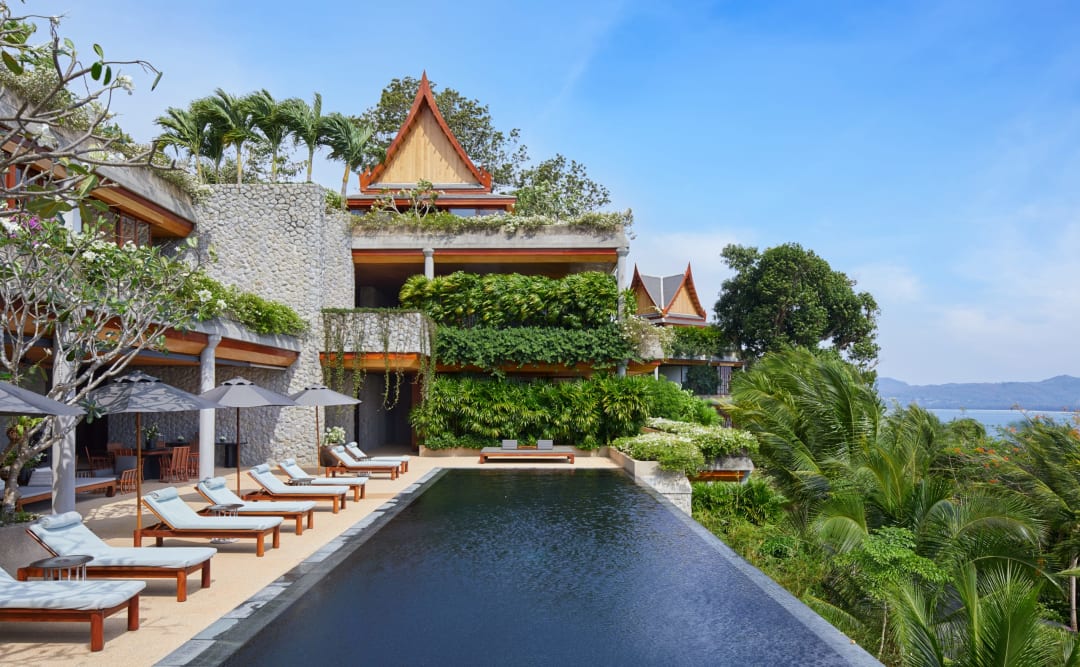
Photo: © Amanpuri
Dining on the peninsula: from traditional Thailand to Japanese washoku
Amanpuri’s status as a flagship property is also evident in its culinary offering, structured around several complementary restaurants. The resort has four dining venues, each exploring a different gastronomic register. The Thai Restaurant pays tribute to local cuisine with a focus on regional traditions, in harmony with the Ayutthaya-inspired architecture described earlier. The dishes continue the spirit of the place: flavourful yet balanced, generous without excess, served in a setting open to the gardens and teak roofs.
Nama, the restaurant dedicated to washoku, presents Japanese culinary art in a pared-back form. The rigour of the preparations and the precision of each gesture mirror Amanpuri’s philosophy, which values exactness over effect. A South American Lounge completes the line-up, shifting the tone with flavours from across South America. Down by the water, the beach and Beach Club offer Mediterranean-style lunches, designed for days shaped by the sea and watersports.
This culinary spectrum, linking Thailand to other shores, reflects a trend seen at several island retreats in the region, such as Soneva Kiri in Trat. Amanpuri, however, stands apart through the seamless way its restaurants integrate into the overall architectural scheme: each one connects to terraces, pavilions and outdoor lounges that reprise the vocabulary of teak, dark granite and multi-gabled roofs. The result is a highly coherent way of experiencing food, always in direct dialogue with the peninsula and the sea.
Pansea Beach, Beach Club and the Andaman Sea: an exceptional coastal resort
Set on a secluded peninsula overlooking Pansea Beach, Amanpuri is inseparable from its relationship with the Andaman Sea. The property includes a stretch of this beach, which becomes a natural extension of the villas and pavilions. The private beach offers a range of watersports, making it possible to explore the coast or simply enjoy the closeness of the water. The site’s topography — wooded slopes running down to the sand — ensures, as already highlighted, a feeling of seclusion without cutting the resort off from the rest of Phuket.
Closer to the sea, the Beach Club that anchors life on the shore features a 20-metre pool, a cocktail lounge and Mediterranean-style dining, ideally suited to days spent moving between swims, boat trips and quiet intervals of rest. This pool complements the main 27-metre pool, tiled in deep midnight blue and set higher within the resort, more oriented towards contemplation of the horizon.
Amanpuri’s maritime dimension extends beyond Pansea Beach itself. The resort employs 600 staff and maintains a fleet of thirteen yachts, used for cruises, scuba diving trips and snorkeling excursions. This fleet enables an active relationship with the Andaman Sea, whether the aim is to explore nearby coastline or to spend a day out on open water. In the same spirit as Ed Tuttle’s architectural design, these activities are conceived for guests who value discretion and finely tuned service over a busy beach-club atmosphere.
Spa, wellbeing and finely tuned service at Aman’s flagship property
Amanpuri is defined by much more than its architecture and its beach: the resort has developed a distinctive approach to wellbeing and service that underpins its flagship status. The AMAN spa includes three couples’ treatment rooms and three single rooms. It offers massages, beauty treatments and holistic healing approaches, complemented by dedicated facilities for yoga and meditation. This focus on contemplative practices aligns directly with the meaning of the name “Amanpuri”, “place of peace”, and with the peninsula’s secluded character.
The resort also has a gym equipped with full-height windows, offering clear views of the landscape so that exercise never breaks the connection with the outdoors. The same attention to setting runs through all services, from welcome to behind-the-scenes logistics, designed to be present without ever feeling intrusive. Guests staying three nights or more benefit, as mentioned earlier, from private airport transfers, a service emblematic of this drive for ease and continuity.
Recognition in the form of a “Three MICHELIN Keys” distinction further underlines this level of ambition, highlighting the blend of captivating design, classical luxury, outstanding setting and first-rate service that defines Amanpuri. The resort positions itself as an address of choice for travellers wishing to experience Phuket in a way that is both highly private and carefully choreographed, with villas conceived as homes, architecture rooted in Ayutthaya’s heritage and a constant, structuring relationship with the Andaman Sea.
Explore the surroundings


Green Elephant Sanctuary Park
Lush park for rescued elephants with opportunities to feed and bathe the animals during guided visits.


Amanpuri: experiencing Phuket in a “place of peace” on its own peninsula
On its Phuket peninsula, Amanpuri concentrates the entire philosophy of the Aman collection: deep anchoring in its site, architecture that honours local culture, villas designed as private residences and service of great precision. The brand’s first resort, opened in 1988 on a former coconut plantation overlooking Pansea Beach and the Andaman Sea, speaks to travellers looking for a discreet, reflective kind of luxury, where every gesture and every space seems designed to set a calmer rhythm.
Whether the idea is to stay in a pavilion with a terrace opening onto the gardens, to gather several generations in a multi-bedroom Ocean Villa with a pool and separate living areas, to enjoy a washoku dinner at Nama or traditional Thai cuisine, to practise yoga and meditation at the AMAN spa or to explore the Andaman by yacht, Amanpuri offers a very personal reading of Phuket. The peninsula becomes a microcosm: a contemporary Thai village designed by Ed Tuttle, set above Pansea Beach, connected to the world by Phuket Airport some thirty minutes away, yet mentally at a comfortable distance from the bustle of the island’s larger resorts.
To discover this emblematic “place of peace”, stays can be arranged via Aman’s official website, which details the pavilion and villa categories available. Amanpuri also appears on major international hotel platforms; whichever channel is used, the experience is shaped from the first exchanges through a personalised relationship with the property.
